The System
The Salt Lake Valley sits at the heart of Utah's water supply, a densely populated urban basin fed by trans-basin imports, mountain snowmelt, and groundwater, all draining ultimately to the Great Salt Lake. Managing this system means tracking water across dozens of agencies, infrastructure networks, land uses, and hydrologic processes simultaneously. Few systems in the Intermountain West are as complex, or as consequential.
The Challenge
A system-wide water balance for the Salt Lake Valley can't be done piecemeal. Imports from the Provo River and Central Utah Project feed municipal distributors and irrigation canals. Demand from cities, farms, and industry draws from multiple overlapping supply sources. Groundwater and surface water exchange continuously. Wastewater treatment plants return flow to the Jordan River. Everything eventually reaches the Great Salt Lake, a terminal lake with no outlet where every drop of consumptive use ultimately shows up as a water-level decline.
Accurately accounting for the full cycle requires integrating all of these components into a single coherent model — not just connecting them loosely, but capturing the feedbacks, timing, and interactions that drive system behavior.
Approach & Methodology
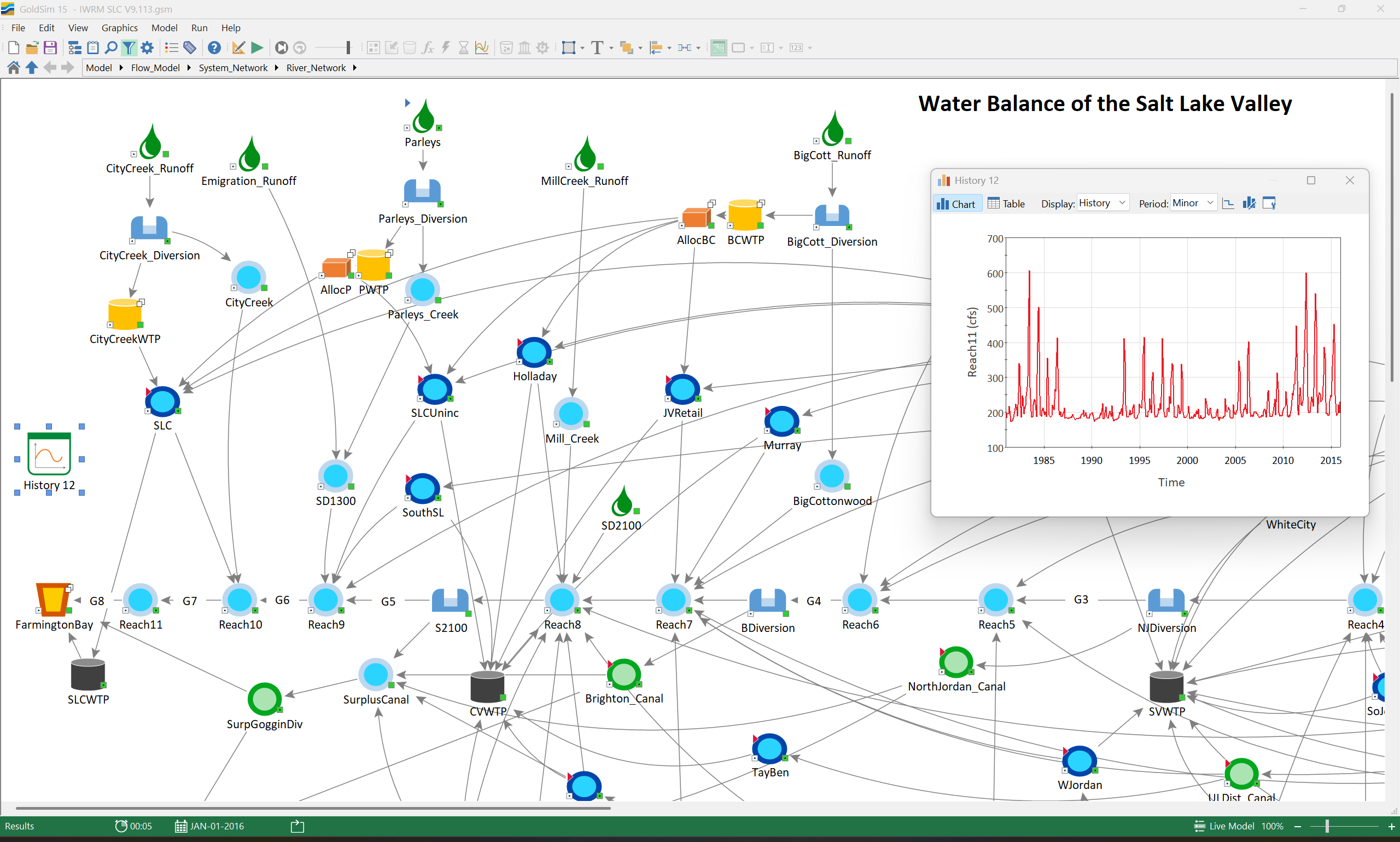
The model was built in GoldSim, a dynamic simulation platform well-suited to complex water systems with probabilistic inputs and interacting components. The model architecture was designed from the ground up to represent the Salt Lake Valley as a complete hydrologic system:
- Trans-basin Imports: Provo River supplies and major conveyance infrastructure delivering water into the valley from the Wasatch Mountains.
- Distribution Networks: Allocations and deliveries across the Jordan Valley Water Conservancy District (JVWCD), Central Utah Water Conservancy District (CUWCD), and the Metropolitan Water District of Salt Lake & Sandy.
- Groundwater–Surface Water Interaction: Integrated groundwater balance components exchange dynamically with surface water flows, capturing the full subsurface contribution to system behavior.
- Municipal Demand & Agricultural Delivery: Simulated end-use demands across urban and agricultural sectors, including irrigation canal routing to agricultural users.
- Wastewater Return Flows: Modeled recycled water contributions from wastewater treatment plants (WWTPs) re-entering the surface water system.
- Great Salt Lake Outflows: Tracked return flows through the Jordan River to the Great Salt Lake, enabling regional water accounting and long-term planning at the basin scale.
My Role
I first developed a water balance model of this system in 2006 (before Great Salt Lake decline had reached its current crisis level) and have worked with it continuously ever since. That span of involvement is unusual and has produced institutional knowledge of the system that goes well beyond what any one project cycle could provide.
Key phases of involvement include:
- Original model development: Built the initial integrated water balance framework, establishing the architecture that subsequent versions built upon.
- University of Utah research collaboration: Donated time to work directly with a University of Utah researcher to develop and extend the model for academic research, contributing to work that supported peer-reviewed publication and graduate research.
- Utah Division of Water Resources (DWR) support: Provided technical advisory support to the State of Utah as they developed the Great Salt Lake Integrated Model (GSLIM), a basin-scale extension of related modeling work. This included model design guidance, review of existing GoldSim model versions, stochastic hydrology development, and staff training.
Outcomes
- Supported regional water accounting across one of Utah's most complex multi-agency water systems.
- Contributed technical foundation to academic research on Great Salt Lake hydrology and Jordan River return flows.
- Informed the State of Utah's Great Salt Lake planning and policy analysis through the GSLIM framework.
- Provided a basis for evaluating long-term drought resilience and the sensitivity of Great Salt Lake inflows to changes in consumptive use.